Glimpses. Two Paintings from a Single Trace
Glimpses. Two Paintings from a Single Trace
Sometimes two paintings begin in the same place and later develop in completely different directions. That is how these two works came into being.

The starting point was glimpses of light between trees. I was not interested in recreating the forest as a landscape. What interested me more was the rhythm of the verticals and the space between them — the places where light passes through the structure of the trees.
The first notation was very free and direct. Blues, turquoises, yellows and greens appeared. The motif was still clearly connected with nature, although even then I was more interested in its construction than in representation itself.
Both canvases were worked on side by side on the same table. While one of the layers of paint was still fresh, I made a contact, mirror-image transfer of parts of it onto the second surface. It became a kind of monotypic transfer — a physical displacement of the trace of one painting onto another.
The intention was not to make a copy. At the moment of transfer, a second structure emerged, sharing the same source but already possessing its own arrangement. Directions were reversed, some traces disappeared, while others appeared in new places. The element of chance created by the contact between the two surfaces became part of the further process.
From that moment on, the paintings developed independently.
The first retained a stronger connection with its organic source. Colour, vertical rhythms and the memory of trees and of light between them remained within its structure. Successive layers of matter partially covered the earlier notation, but did not erase it. That painting was completed and is now in a private collection.
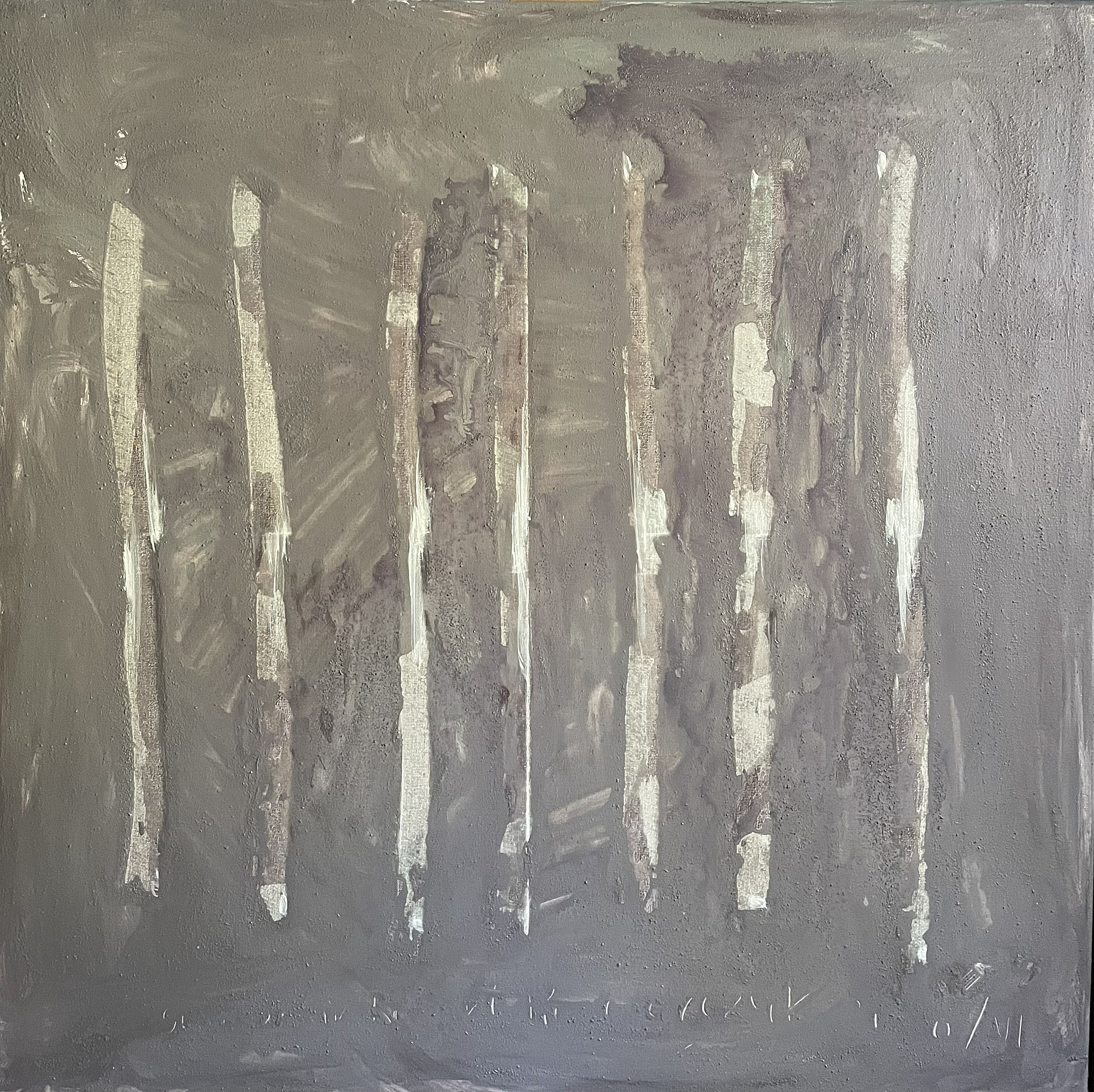
The second work moved in the opposite direction. Its starting point was no longer the direct experience of the landscape, but the mirrored trace of the first painting. In a sense, from the very beginning it stood one step further away from reality.
Gradually, I removed everything that made the forest too easy to recognise. I reduced the colour, covered earlier layers and left above all the vertical rhythm and differences in light. The bright bands ceased to function as tree trunks. They began to exist independently — as directions, intervals and traces. In subsequent stages, the surface itself also changed. Fresh layers reflected light strongly, the relief revealed itself differently depending on the viewing angle, and as the painting dried it gradually lost its gloss and became more tonally restrained.
At a certain point, the trees were no longer necessary.
What remained were glimpses.
This is therefore not an abstraction constructed from abstract signs from the outset. Its structure has a concrete source in reality, while its relationship with the first painting was also recorded physically — through the contact of a fresh painted layer with the second canvas.
The path led from direct experience, through the first notation and its mirrored transfer, to two independent paintings. What was representational gradually disappeared, but it was not annulled.
It remained in the rhythm of the verticals, in the space between them, and in the oldest layer of the painting — now almost invisible, yet still participating in its construction.
This is precisely what interests me in painting with layers. One layer may cover another, but it does not have to remove it from the painting. Something may cease to be visible and still remain part of the work.
In the case of “Glimpses”, I was also able to preserve this path in photographs.
Two paintings emerged from the same experience.
One retained the memory of the landscape.
The other retained its trace.
Glimpses
Sławomir Piwowarczyk, 2026
100 × 100 cm · acrylic · impasto