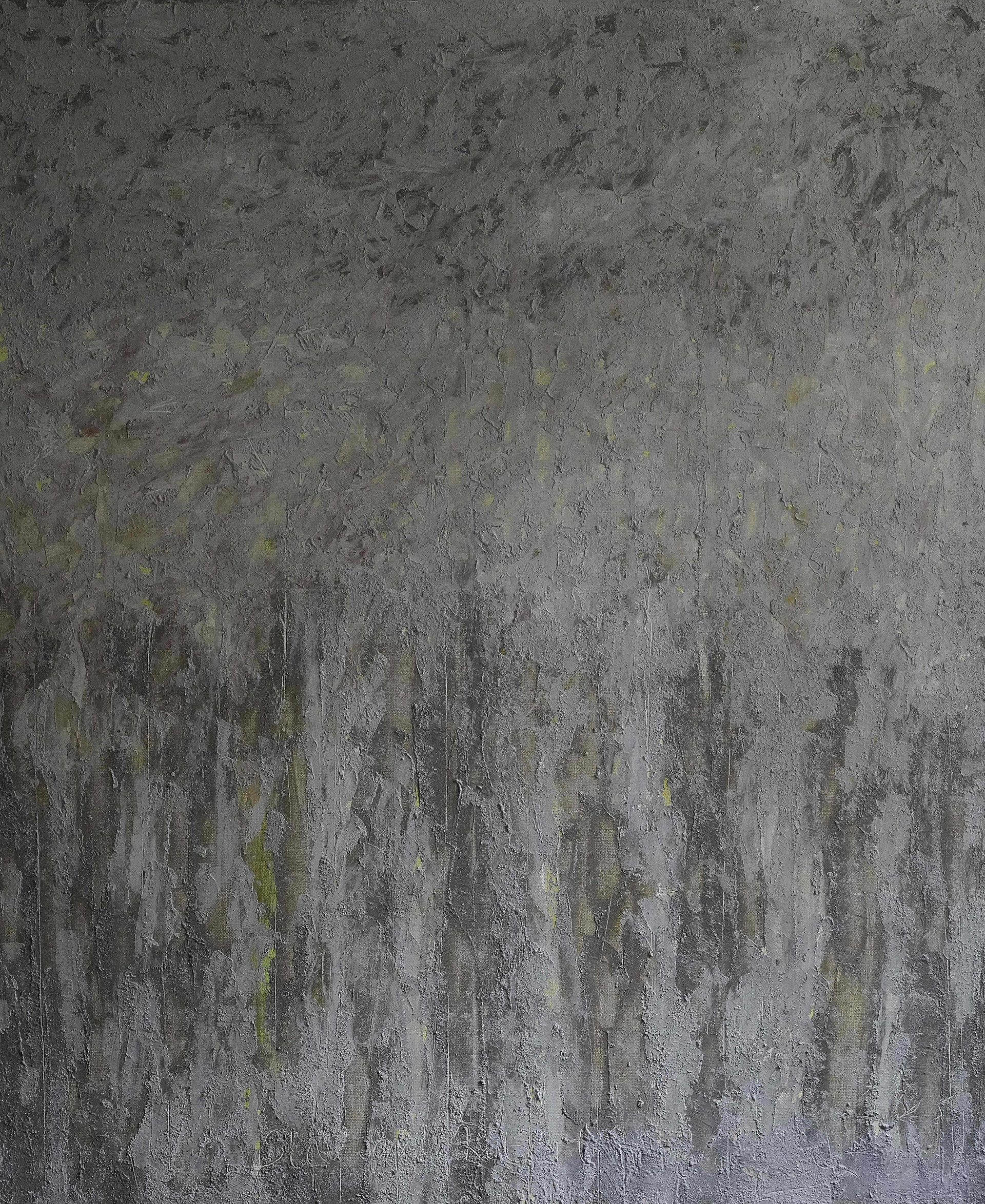
The Alchemy of Painting. On the Transformation of Light, Matter and Memory
The Alchemy of Painting. On the Transformation of Light, Matter and Memory
Sometimes I think that painting contains something of alchemy.
Not the old alchemy that promised to turn metal into gold. I am more interested in another kind of transmutation — one that actually takes place. Matter passes from one state into another, something disappears, something remains, and something returns after time in an entirely new form.
In “Cycle of Light”, this process became particularly clear to me.
The starting point was a landscape from my family’s home region. Vertical trees, dense crowns, light forcing its way between them. At first, the painting was much more colourful. Those first layers could already have been considered a finished painting.
But I did not feel that the process was complete.
So I began to cover what had already been created.
New matter entered the surface: pigments, acrylic medium and ash from my home stove. The same fire that heats my home leaves behind ash that later finds its way into my paintings.
And this is where, for me, something begins that is difficult to describe simply as technique.
The wood grew through light. Over the years it stored energy within its matter. In the fire, it released that energy again as warmth and light. What remained was ash — a trace of transformation.
Then that ash enters the paint.
It mixes with pigment, becomes part of the impasto and joins the surface of the painting. It ceases to be merely the end of something that has burned. It begins a new life.
And it encounters light once again.
Light falls across the painting, catches on the edges of the relief, enters its recesses, reveals subtle differences in colour and is reflected back towards the eye.
In a sense, it returns to where everything began.
Light passes into wood. Wood passes through fire. Fire leaves ash. Ash passes into the painting. The painting begins to work with light once again.
This cycle moves me deeply.
But the transformation does not take place only in the materials.
It also takes place within the painting itself.
The first vivid colours were covered. Yet they did not disappear completely. They remained beneath the surface. Later, they began to return.
I scratched through successive layers. I rubbed them with my fingers. I moved the material with my hand. I used tools, sometimes even a nail, to disturb what I had previously applied.
Each gesture removed something and revealed something else.
What reappeared was no longer the same colour it had been before. It returned filtered through another layer, through ash, through chance and conscious decision, through several days of work.
Perhaps this is why I sometimes think of the canvas as an altar of transformation.
Not in a religious sense.
Rather as a place where something is placed, transformed and returned in another form.
Matter, the movement of the hand, time, light and memory meet on the canvas.
Paint alone is not enough.
The painting has to pass through successive states.
Sometimes something good has to be covered so that it can return in a more interesting form. Sometimes a fragment that already works has to be destroyed in order to discover what lies beneath it. Sometimes the surface has to be allowed to become ugly, heavy, even brutal.
Seen close up, “Cycle of Light” can indeed be brutal.
There are scratches, sharp edges, lumps, ruptures in the surface, places that almost resemble wounds.
And yet, from a few steps away, those same fragments begin to create delicate transitions, light and rhythm.
This is one of the things that interests me most in painting:
delicacy does not always arise from a delicate gesture.
Sometimes it is born precisely from friction, pressure, scratching, covering and uncovering again.
The painting remembers all these actions, even when the viewer can no longer recognise their sequence.
Time remains within the layers.
The first landscape remains.
The colour that is barely visible remains.
The ash remains.
The movement of the hand remains.
The thought that appeared during the process and changed the next decision remains.
That is why I am less and less interested in a painting understood simply as a surface that has to be “beautifully finished”.
I am more interested in the painting as a place of transformation.
Matter receives another life there.
Ash is not the end of wood.
A covered colour is not a lost colour.
A scratch is not merely damage to the surface.
Each of these elements can become the beginning of the next stage.
And perhaps this is my own private alchemy.
Not the transformation of metal into gold.
The transformation of light into matter, matter into memory, memory into gesture, and gesture once again into light.
“Cycle of Light” is a deeply personal painting for me. That is why I do not want to sell it.
I want it to remain in my home.
But I do want to show it, because it speaks very clearly about what painting has become for me.
Not the reproduction of the world.
Not the decoration of a canvas.
But a conscious participation in transformation.